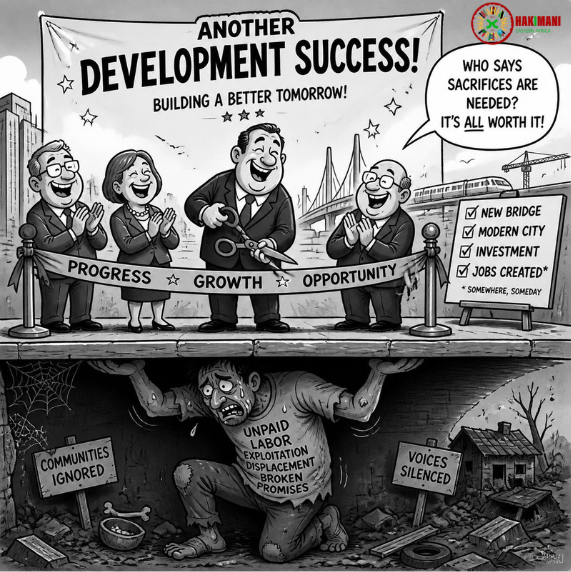
Every Development Success Story Has a Footnote
By Ms. Susan Nzomo
A new road is built. A city expands. GDP rises. A major investment arrives. Thousands of jobs are announced.
The headlines celebrate progress. Reports highlight achievements. Photographs capture the ribbon-cutting, the new infrastructure and the promises of a better future.
But beyond the headlines, there is a question we do not ask often enough:
Who paid the price for that progress?
Who lost their land? Who was displaced? Whose livelihood disappeared? Who can no longer afford to live where they once did? Who was consulted—and who was simply informed?
And perhaps the most uncomfortable question of all: whose suffering is considered an acceptable cost of development?
When success is measured in numbers
Development is often presented through measurable achievements: kilometres of road constructed, investment attracted, jobs created, schools built, households reached and economic growth recorded.
These indicators matter. Infrastructure can connect communities to markets, investment can create opportunities, and economic growth can improve living standards.
But these numbers tell only part of the story.
A road may improve transport while disrupting the livelihoods of families along its route. An urban redevelopment project may modernize a neighborhood while making housing unaffordable for some of its original residents. An investment may generate employment while leaving surrounding communities with limited access to the opportunities created.
These are not inevitable outcomes of development. They are questions that should be examined before, during and after a project is implemented.
A project can achieve its targets and still leave important human questions unanswered
How many people gained opportunities? How many lost something essential? Were those affected adequately consulted? Were their rights protected? And when harm occurred, could they access a fair remedy?
If we measure only what a project delivers, we risk overlooking what it takes away.
The people behind the progress
For a family, land is rarely just an economic asset. It may be a home, a source of food, a livelihood, a cultural connection and the foundation of future security.
For a small business, a new road or redevelopment project may bring customers—or disrupt the trading space on which its survival depends.
For a community, development may create new opportunities while changing social relationships, access to shared resources and the ability to remain in a familiar environment.
These experiences complicate the neat narratives of success often found in development reports.
They also raise a fundamental issue of justice: who gets to define what progress looks like?
If success is defined exclusively by governments, investors, technical experts or project implementers, the priorities of affected communities can become secondary.
A consultation meeting may take place. Attendance sheets may be completed. Community views may be recorded. Yet the real test is whether those views influence decisions—and whether people can understand, question and challenge the outcomes.
Being present in a consultation is not the same as having meaningful influence over a decision.
And being informed about a project is not the same as having a say in how it affects your life.
Development without dignity is an incomplete measure of progress
The challenge is not to stop development. It is to pursue development that recognises people as rights-holders and participants, rather than treating them as obstacles to implementation or unavoidable statistics in a project report.
This requires asking harder questions at every stage.
Before a project begins: Have affected communities helped shape the priorities? Have potential social and environmental costs been assessed? Are the people most likely to be harmed being heard?
During implementation: Are commitments being honoured? Can communities raise concerns without fear? Are complaints addressed transparently and fairly?
After completion: Who has benefited? Who has been left worse off? Were harms remedied? Can the people have affected point to a meaningful improvement in their lives?
These questions should matter to governments responsible for public welfare, investors accountable for the consequences of their decisions, development partners financing interventions, and civil society organizations working to advance justice.
They should also influence how success is measured.
Beyond asking how much was invested or how many people were reached, we must ask whether people gained security, dignity, meaningful opportunities and greater influence over the decisions shaping their futures.
A different understanding of success
At Hakimani Eastern Africa, our commitment to social transformation is rooted in human dignity, justice and the common good. These principles require us to look beyond the visible achievements of development and examine what those achievements mean for the people whose lives they touch.
The central question is not simply whether a project was completed, a target achieved or an economy expanded.
It is whether development has improved people’s lives without making the most vulnerable carry a disproportionate share of its costs.
This calls for a broader understanding of progress—one that values participation alongside infrastructure, human dignity alongside economic growth, and accountability alongside investment.
It also demands humility from those who design and implement development programmes. Communities possess knowledge about their own circumstances that cannot always be captured in project documents, indicators or consultation reports.
Listening to that knowledge is not an optional courtesy. It is part of understanding what meaningful development requires.
The question we must not leave out
Every development success story deserves scrutiny—not because progress should be dismissed, but because progress should be accountable to the people in whose name it is pursued.
So, the next time we celebrate a new road, a major investment, an expanding city or a rising economic indicator, let us ask one more question.
Who benefited, who bore the cost, and what happened to the people whose lives were made harder in the process?
Because the true measure of development is not only how much a country builds, how fast an economy grows or how impressive its achievements appear.
It is also whether people can live with dignity, exercise their rights and participate meaningfully in shaping their own future.
If the success of development depends on people whose losses never make it into the report, then the story of progress is not yet complete.
#HakimaniEasternAfrica #SocialJustice #HumanDignity #IntegralHumanDevelopment #InclusiveDevelopment #Accountability #SocialTransformation #EasternAfrica