Digital Crossroads: Guiding the Questioning Generation
By Ms. Teresia Muia
“Why are young people like this?”
That was the honest question raised by Catholic religious formators during a session facilitated by the Loyola Centre for Media and Communications (LCMC) at the Carmelite Community in Karen, Nairobi.
The engagement centered on the theme of digital culture, as highlighted in the final Synod document, which calls the Church to understand and accompany people within the realities shaping their lives today. Guided by facilitators from LCMC, the session was led by Dr. Elias Mokua, SJ, alongside a team comprising Sr. Lydia Okang’a of the Sisters of Mary of Kakamega, Eric Mwaniki, a Jesuit scholastic, Ms. Teresia Muia, LCMC staff member in charge of the Digital Culture program, and Sr. Elizabeth Nziwa, a lecturer at the Catholic University of Eastern Africa. Together, they engaged the formators in reflecting on how digital transformation is reshaping identity, authority, and religious formation.
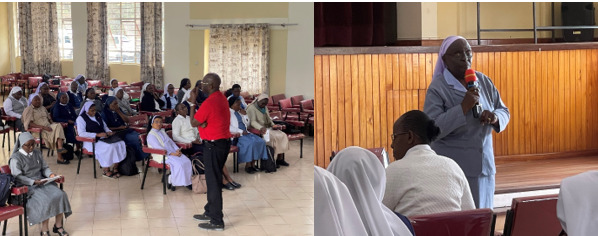
Left: Dr. Elias Mokua, SJ. Right: Sr. Elizabeth Nziwa of the Assumption Sisters of Nairobi leading discussions on digital culture and its influence on religious formation at the Carmelite Community in Karen.
The presentations unpacked the dramatic technological shifts that have shaped today’s generation starting from the early internet era to social media, and now artificial intelligence and hyper-connectivity.
Formators expressed concern that the young women in formation today are more questioning than previous generations. Instead of silent compliance, they often ask: “But Sister, why can’t we do it like this?”
The session emphasized a crucial insight: formation must understand context before correcting behaviour. Today’s generation has grown up in a world of constant connectivity, instant information, algorithm-driven content, and shifting digital authority. Where authority was once rarely questioned, it is now examined. Where silence was normal, stimulation is constant.
Among the challenges identified were difficulty with silence, fear of missing out, reduced resilience, and struggles with long-term commitment. Yet the facilitators urged the sisters to see beyond the tension.
“You are not accompanying a lost generation,” they affirmed. “You are accompanying a searching generation.”
Beneath the questions lies a deep desire for meaning, authenticity, and justice. The digital generation is socially aware, globally connected, and creatively expressive; qualities that, if properly accompanied, can enrich religious life.
The central question remains: How do we form depth, discipline, and faith in a generation shaped by speed and algorithms?