What Does Faith That Does Justice Actually Mean in 2026?
By: Rev. Fr. James Kayanda, SJ
There is a phrase at the heart of the Jesuit tradition that has travelled across generations:
Faith that does justice.
It is a powerful idea. But perhaps, in 2026, we need to ask a simple question:
What does it actually mean?
What does faith that does justice look like when a young person has qualifications but cannot find meaningful employment?
What does it look like when a child sits in a classroom without the basic materials needed to learn?
What does it look like when communities lose livelihoods because of drought, floods or a changing climate?
What does it look like when people live with the consequences of conflict long after political leaders have signed peace agreements?
What does it look like when citizens have rights on paper but struggle to make those rights a reality?
And what does it look like when young people are constantly told that they are “the future” while decisions about their future are being made without them?
These are not simply development questions. They are questions about human dignity, justice and the kind of society we are building. And therefore, they are questions of faith.
Faith cannot remain indifferent to suffering
Faith can be deeply personal. It can be found in prayer, worship, reflection and the relationship between an individual and God. But faith also has a public dimension. If we believe that every person possesses inherent dignity, then what happens to that belief when we encounter poverty? If we believe in the dignity of human life, what does that require of us when children are excluded from opportunities? If we believe in the common good, what responsibility do we have when systems consistently benefit some people while leaving others behind? If we believe in peace, can we remain silent when injustice is allowed to become one of the causes of conflict?
Faith that does justice therefore cannot be indifferent to the conditions in which people live. It asks us to see the person behind the problem.
The farmer behind the climate statistics.
The child behind the education figures.
The young person behind the unemployment numbers.
The family behind the displacement statistics.
The community behind the development project.
And once we see the person, it becomes much harder to remain comfortable with the injustice.
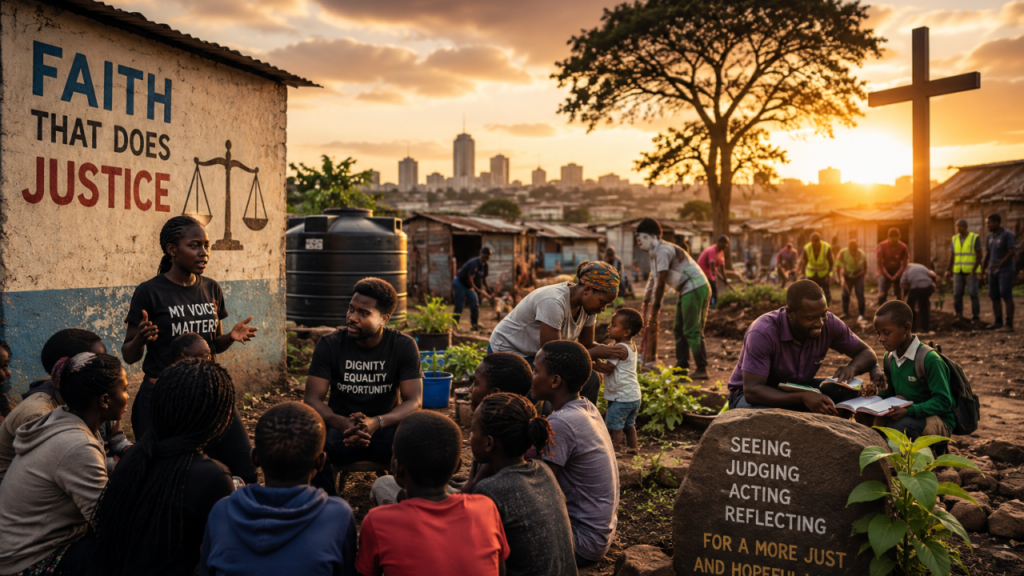
Justice asks us to look beyond charity
There is an important place for charity. When someone is hungry, we feed them. When a family loses everything in a disaster, we help them rebuild. When children lack learning materials, we mobilise resources. When communities face immediate crisis, we respond. But faith that does justice asks us not to stop there.
It asks: Why are people repeatedly being left vulnerable in the first place?
Why does the same community experience drought, lose livelihoods, recover, and then face the same crisis again?
Why does a child enter school but still lack the resources needed to learn?
Why do young people continue to struggle to access opportunities despite policies designed to empower them?
Why do communities participate in consultations but remain excluded from decisions?
Why do peace agreements sometimes fail to address the inequalities and grievances that contributed to conflict?
These questions move us from relief to transformation. From asking: “How can we help?”
to also asking: “What must change?”
In Eastern Africa, the questions are urgent
Eastern Africa is a region of extraordinary potential. It is home to young populations, vibrant communities, rich cultures, remarkable creativity and enormous natural resources. But it is also a region experiencing profound challenges. Climate change is putting pressure on livelihoods and natural resources. Conflict and political instability continue to affect communities. Poverty and inequality limit opportunity. Governance challenges weaken trust in institutions. Young people often struggle to find meaningful avenues for participation. And communities living at the margins can find themselves carrying the greatest burden of problems they did not create. These realities demand more than technical solutions. They require us to ask questions about justice.
Who has access to resources?
Who gets heard?
Who makes decisions?
Who bears the cost when systems fail?
Who benefits from development?
And perhaps the most uncomfortable question: Who is being left behind?
Faith that does justice cannot be afraid of these questions.
Justice also means caring for our common home
Climate change has perhaps made the connection between faith and justice even clearer. The environment is not separate from human life. When rainfall patterns change, livelihoods change. When water becomes scarce, families face difficult choices. When crops fail, food security suffers. When pastoralists lose livestock, household economies collapse. When disasters destroy homes and infrastructure, children and vulnerable communities often bear the consequences. This is why ecological responsibility cannot be separated from social justice.
The question is not simply: How do we protect the environment?
It is also: How do we protect the people whose lives depend most directly upon it?
And: Who has the resources to adapt—and who does not?
For Hakimani, this connection between faith, justice and care for our common home is central to the work of social transformation. Because a healthy environment without social justice is incomplete. And social justice without care for creation cannot be sustained.
What does faith require from us when young people are excluded?
There is another question that deserves our attention. We often speak about young people as leaders of tomorrow. But young people are not waiting for tomorrow to experience today’s problems. They are living through them now. They are experiencing unemployment. They are navigating climate anxiety. They are witnessing political and social divisions. They are trying to understand their place in societies where opportunities are not always distributed fairly.
So perhaps instead of asking: “How do we prepare young people for the future?” we should ask: “How do we create a society in which young people can shape the present?”
That means more than inviting young people to events. It means creating genuine opportunities for participation. It means listening to their ideas. It means giving them the skills and platforms to engage. And, importantly, it means being willing to share power.
Participation without influence is not meaningful participation.
Faith that does justice should therefore create space for young people not merely to be recipients of programmes, but contributors to the transformation of their communities.
Justice requires courage
It is relatively easy to speak about compassion. It is harder to speak about injustice. Compassion may lead us to help someone. Justice may require us to ask why the same person keeps needing help.
Justice can make institutions uncomfortable; It can challenge traditions, it can question power, it can require us to speak when silence would be easier and it can ask us to stand beside people whose experiences are different from our own. That is why faith that does justice requires courage. Not the courage to condemn everyone else. But the courage to examine ourselves.
Where do we benefit from systems that disadvantage others?
Where have we become comfortable with inequality?
Whose suffering have we normalized?
Whose voice have we stopped hearing?
These questions are uncomfortable precisely because they demand something from us. They demand change.
Social transformation is not about doing more projects
This distinction is important for organizations like Hakimani. Social transformation cannot simply mean having more programmes, more activities or more beneficiaries.
A project can end.
A grant can end.
A training can end.
But the question is whether something deeper has changed.
Has a community gained greater agency?
Has a young person gained a meaningful voice?
Has an institution become more accountable?
Has a harmful system been challenged?
Has a community become more resilient?
Has a relationship been restored?
Has a person been able to claim a right they previously could not access?
Has a society become a little more just?
That is transformation.
And that is why Hakimani’s work sits at the intersection of faith, justice, peace, human rights, ecological responsibility and community empowerment. The goal is not simply to respond to suffering. It is to accompany people and communities as they seek to understand the challenges they face, strengthen their capacity, claim their rights and participate in shaping better futures.
So, what does faith that does justice mean in 2026?
Perhaps it means refusing to separate prayer from responsibility.
- It means seeing faith not only as something we profess, but something we practice. It means feeding someone who is hungry—but also asking why they remain hungry.
- It means supporting a child to access education—but also asking what prevents other children from accessing the same opportunity.
- It means responding to a climate disaster—but also investing in resilience and asking why some communities are repeatedly exposed to greater risk.
- It means supporting peace—but also addressing the injustices that make peace fragile.
- It means empowering young people—but also giving them genuine space to influence the decisions that affect their lives.
- It means defending human dignity even when doing so is inconvenient.
- And perhaps most importantly, it means refusing to accept injustice as inevitable.
Because faith that does justice is not simply about doing good things for people. It is about helping create a world in which people can live with dignity, agency, opportunity and hope.
That is a much more demanding definition of faith.
But perhaps that is exactly why we need it.
Don’t just ask what we did for people. Ask what changed in the conditions that shape their lives.
In 2026, perhaps that is what faith that does justice must mean. Not faith that looks away from the world’s problems.
Faith that enters them. Not faith that speaks only about hope.
Faith that helps create the conditions for hope. Not faith that simply asks for transformation.
Faith that participates in it. And perhaps the question for each of us is not simply:
“What do I believe?”
But:
“What does my belief require me to do?”