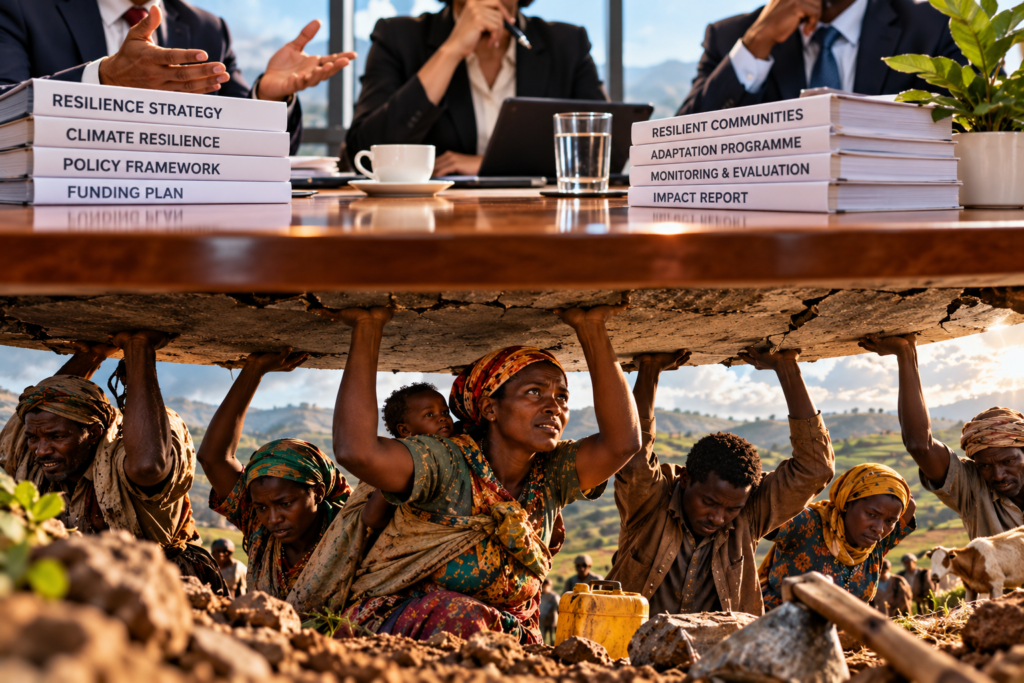
What Resilience Looks Like Before It Becomes a Policy Word: Lessons From Ethiopia
By Ms. Susan Nzomo
Before resilience appears in a government strategy or a donor report, it is already being tested in people’s homes, farms and communities.
A farmer watches the rains fail and begins looking for another way to grow food.
A family displaced by conflict tries to rebuild a livelihood in a place it never expected to call home.
A pastoralist searches for water as livestock weaken and familiar grazing routes become less reliable.
A mother weighs the cost of today’s food against the money needed to keep her children in school.
None of these people may use the word resilience to describe what they are doing. Yet they are confronting the very challenges that governments, humanitarian agencies and development partners discuss when they talk about building resilient communities.
But there is an uncomfortable question we must ask:
When we call people resilient, are we recognising their capacity to rebuild—or celebrating their ability to survive conditions that should never have been allowed to persist?
Ethiopia offers an important lens through which to examine this question.
Across parts of the country, communities are confronting overlapping pressures from conflict, displacement, drought, flooding, economic insecurity and disrupted livelihoods. These pressures do not operate independently. They reinforce one another, making recovery more difficult and pushing already vulnerable households towards further hardship.
In this context, resilience cannot simply mean enduring another crisis. It must mean having a realistic opportunity to recover, adapt and build a more secure future.
The problem with celebrating survival
The language of resilience has become central to development policy. We talk about resilient livelihoods, resilient food systems, resilient communities and resilient institutions.
The concept matters. Communities need the capacity to withstand shocks and adapt to changing circumstances. But the language becomes dangerous when it shifts attention away from the conditions people are forced to endure.
A farmer who loses a harvest to drought and borrows money to plant again may be demonstrating determination. But if the next failed season leaves that farmer in deeper debt, has resilience really been strengthened?
A displaced family that finds temporary shelter and starts earning an income has made important progress. But if insecurity, poor access to services and the absence of secure livelihood opportunities continue to undermine recovery, how durable is that progress?
A community that repeatedly organises its own response to water shortages demonstrates initiative. But if the infrastructure, resources and public support needed to address those shortages never arrive, should that community’s resilience become an excuse for institutional inaction?
People should not have to become exceptionally resilient simply to survive systems that repeatedly fail them.
Resilience must not become a polite way of transferring responsibility from institutions to individuals and communities.
People have a role in shaping their own futures. But they cannot be expected to overcome every obstacle without access to resources, public services, security, information and meaningful influence over the decisions affecting their lives.
The question is not simply whether people can cope with adversity. It is whether the conditions surrounding them allow recovery to last.
Ethiopia shows why resilience cannot be separated from livelihoods
Consider the experience of conflict-affected communities in Ethiopia’s eastern Oromia Region.
In April 2026, the Food and Agriculture Organization of the United Nations documented the experiences of households rebuilding their livelihoods after displacement. One farmer, Ashenafi Yadeta, had previously depended on food assistance. With support from local authorities and the host community, he began cultivating staple crops and diversifying his farm. Through additional support, he adopted climate-smart farming practices, integrated fruit trees with staple crops and improved water efficiency through simple drip irrigation.
Another participant, Hayate Adem, who had lost loved ones and family property during displacement, received goats through livelihood support. The animals offered a potential source of income while improving her family’s access to milk.
These experiences reveal something important about resilience.
It is not merely the ability to withstand hardship. It is the ability to regain options.
For Ashenafi, resilience meant having practical ways to protect agricultural production against unreliable rainfall. For Hayate, it meant gaining an asset that could support household nutrition and future income.
Neither example suggests that one intervention can resolve the wider challenges facing Ethiopia. But both demonstrate how appropriate support can help people move beyond immediate survival towards a more secure livelihood.
The difference is fundamental.
Emergency assistance can help a family survive today. Livelihood support, functioning services, access to resources and opportunities to adapt can help that family face tomorrow with greater confidence.
Resilience begins to change a person’s life when survival is no longer their only available option. You cannot build resilience while ignoring the systems that produce vulnerability.
There is another lesson from Ethiopia: resilience cannot be built through isolated interventions alone.
A farmer may receive drought-tolerant seeds but lack reliable access to water. A pastoralist may receive livestock support but continue to face severe pressure on grazing land. A displaced household may receive livelihood assistance but struggle to access healthcare, education, markets or secure land.
Each intervention may be valuable. Yet its long-term impact depends on the conditions surrounding it.
Research examining Ethiopia’s Productive Safety Net Programme in conflict-affected areas of Amhara and Oromia highlights this challenge. A 2026 study found that social assistance offered important protection, but often fell short of reducing long-term vulnerability where households faced persistent, overlapping shocks and inadequate support. The researchers emphasised the importance of consistent funding, complementary services, stronger livelihoods and peace and stability.
The lesson extends beyond social protection.
Climate adaptation cannot be separated from access to water, land and agricultural services. Livelihood recovery cannot be separated from security and functioning markets. Community development cannot be separated from public institutions that respond to people’s needs.
A household cannot be expected to become resilient when the systems it depends on remain unreliable.
This demands a different approach to development: one that connects emergency assistance with longer-term recovery, links environmental protection with livelihoods, and recognises that lasting change often requires several institutions and interventions to work together.
It also requires governments and development partners to examine whether their programmes are addressing the causes of vulnerability—or merely managing its consequences.
Communities are already building resilience. Are institutions keeping pace?
One of the most overlooked aspects of resilience is the knowledge and initiative that already exist within communities.
Farmers experiment with crops and cultivation methods. Pastoralists draw on knowledge of local landscapes and livestock. Families diversify their income sources. Neighbours share resources and support one another through periods of hardship.
These efforts matter. They reflect local experience, practical problem-solving and the determination to protect livelihoods.
But community knowledge should not be romanticised, and local initiative should not be mistaken for sufficient support.
A farmer’s knowledge cannot make rainfall predictable. Community cooperation cannot, on its own, restore every damaged public service. A pastoralist’s experience cannot eliminate the consequences of prolonged drought or insecurity.
Communities need their knowledge to be recognised and combined with appropriate technical expertise, reliable information, adequate resources and responsive institutions.
They also need a meaningful role in determining what support looks like.
Too often, development programmes define community needs, select interventions and establish success indicators before the people expected to benefit have had a meaningful opportunity to shape those decisions.
Yet people living through a crisis often understand its consequences in ways that external institutions may overlook. They know which resources are becoming scarce, which coping strategies are no longer working and which solutions are practical within their circumstances.
Resilience is stronger when communities are not simply taught how to adapt, but are given the resources and influence to determine how adaptation happens.
This means involving communities in identifying risks, choosing priorities, managing resources and evaluating outcomes. It means listening when people explain why an intervention is not working. And it means recognising that communities are partners in recovery, not passive recipients of assistance.
What should donors and governments measure instead?
If resilience is more than survival, then our measures of success must change.
The number of households receiving assistance matters. The number of farmers trained matters. The number of water systems constructed or hectares restored matters.
But these figures tell us what has been delivered, not necessarily whether people’s lives have become more secure.
A better assessment asks what changed after the intervention.
Can a household maintain its livelihood after the next climate shock? Has access to water become more reliable? Are families less dependent on emergency assistance because they have gained viable livelihood options? Can displaced people access essential services and rebuild their lives with dignity? Do communities have a stronger voice in decisions affecting their future?
These questions require longer-term monitoring, honest feedback and a willingness to acknowledge when progress is limited.
They also demand that donors look beyond short funding cycles. Resilience takes time to build, particularly where conflict, environmental pressures and economic insecurity interact.
A project may achieve its immediate targets while leaving the underlying causes of vulnerability largely untouched.
If that happens, the response should not be to declare success and move on. It should be to learn, adapt and address what remains unresolved.
The real test of resilience is not how well people survive a crisis. It is whether they are better equipped to face the next one without losing everything they have rebuilt.
Resilience must protect dignity, not simply preserve survival
At Hakimani Eastern Africa, the discussion about resilience connects directly to our commitment to integral human development, climate justice and human dignity.
People are not merely households to be protected against shocks. They are individuals and communities with aspirations, knowledge, relationships and the right to shape their futures.
A resilient community should not be defined only by how much hardship it can endure. It should also be defined by whether people can access essential services, protect their livelihoods, participate in public decisions and pursue opportunities without living permanently on the edge of crisis.
This understanding changes the questions we ask.
Instead of asking only how communities can cope with drought, we ask what will make their livelihoods more secure.
Instead of asking only how displaced households can survive, we ask what conditions will enable them to recover with dignity.
Instead of asking only how communities can adapt, we ask whether institutions are providing the support and opportunities necessary for adaptation to succeed.
And instead of celebrating resilience as an inherent quality of people living through hardship, we ask what responsibilities governments, donors, civil society and development partners have in strengthening it.
This is particularly important in Ethiopia, where climate-related hazards, displacement and insecurity can intersect to create prolonged and complex challenges.
The response must be equally connected: immediate assistance where needed, livelihood recovery, climate adaptation, functioning public services, community participation and sustained efforts to address insecurity.
No single intervention can deliver all of this. But coordinated action can help ensure that progress in one area is not undermined by neglect in another.
Before we call a community resilient, ask what it has been forced to endure
Resilience is a valuable concept. It reminds us that people can adapt, innovate and rebuild even under difficult circumstances.
But it should never become a label that makes prolonged suffering more acceptable.
When a farmer repeatedly loses crops, we must look beyond the farmer’s determination and examine the support available to protect agricultural livelihoods.
When displaced families struggle to rebuild, we must look beyond their ability to cope and consider the conditions required for recovery.
When communities organise their own responses to environmental and economic pressures, we must recognise their initiative while asking whether institutions are meeting their responsibilities.
And when a development programme claims to have built resilience, we must ask whether people’s lives have become measurably more secure.
For Ethiopia, and for development partners working across Eastern Africa, this is the challenge: move beyond helping people endure adversity towards changing the conditions that make adversity so devastating.
At Hakimani Eastern Africa, we invite policymakers, donors, civil society organisations and community leaders to reconsider what resilience should mean in practice.
Are we helping communities recover—or simply helping them survive another crisis?
Are we supporting local knowledge and leadership—or making decisions on communities’ behalf?
Are we measuring activities completed—or whether people have gained the resources, opportunities and influence to shape their own futures?
Before resilience becomes another policy word, it must become something people can experience: a livelihood that survives a shock, a family that can recover without falling deeper into poverty, a community that has a meaningful voice, and a future that offers more than the prospect of surviving the next crisis.
Because resilience should not mean learning to live with hardship forever.
It should mean having a fair chance to overcome it.
#Ethiopia #Resilience #ClimateJustice #CommunityResilience #HumanDignity #Livelihoods #IntegralHumanDevelopment #SocialTransformation #HakimaniEasternAfrica