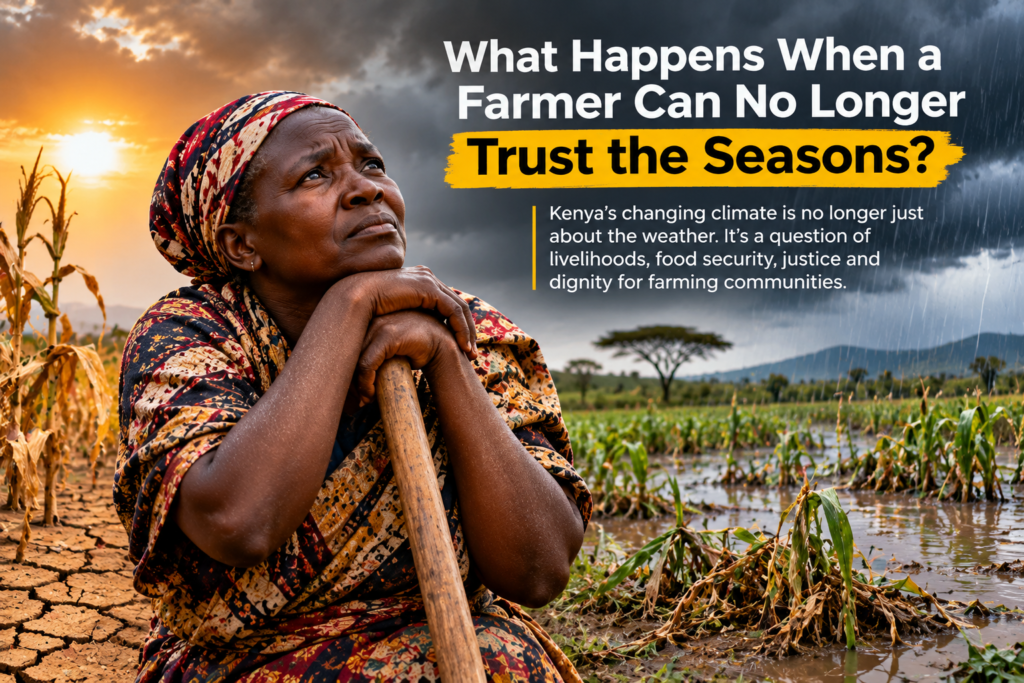
What Happens When a Farmer Can No Longer Trust the Seasons?
By Ms. Susan Nzomo
Kenya’s changing climate is becoming a question of livelihood, justice and human dignity.
For generations, a farmer could look to the seasons for guidance. The first rains offered a signal to prepare the land. The planting season brought decisions about seeds and labour. The harvest promised food for the family, income for school fees and something to carry into the next season.
That knowledge was built over years of observing the land, reading the skies and learning from previous generations.
But what happens when the rains arrive late, stop too early, or fall so heavily that they wash away what a farmer has worked for months to grow?
What happens when the seasons can no longer be trusted?
For many farming communities in Kenya, this is not an abstract climate debate. It is a question of whether the next harvest will feed a family, whether borrowed money can be repaid, and whether a farmer can afford to plant again.
When the weather becomes a livelihood risk
Kenya’s climate is changing. The Kenya Meteorological Department’s State of the Climate Report 2025 documents rising temperatures and increasingly uneven rainfall, with significant consequences for agriculture, water resources and livelihoods. In some arid and semi-arid areas, crop yields have fallen below long-term averages, while excessive rainfall has also damaged crops in flood-prone areas.
The contradiction matters. Some farmers struggle because the rain does not come; others struggle because too much arrives at once. A season that benefits one region may expose another to losses.
For a smallholder farmer who depends on rain-fed agriculture, this uncertainty can make every decision more expensive. Buy seeds now or wait? Apply fertilizer before the next rainfall or risk losing the investment? Plant again after crop failure or preserve what little money remains?
These are not simply farming decisions. They are decisions made under financial pressure, with consequences for food, education, health and family stability.
The problem is not only the climate. It is who carries the risk
Climate change does not affect every farmer equally.
A farmer with irrigation, savings, reliable weather information, access to credit and agricultural extension services may have options when the rains fail. A farmer without these resources may have little room to recover from a single bad season.
This is where climate change becomes a question of justice.
Why should the ability to survive a climate shock depend so heavily on a farmer’s income, location or access to public services?
Farmers cannot control regional rainfall patterns. Yet they are often left carrying the financial consequences when those patterns change. They are expected to adapt, diversify and become resilient, even where the resources required to do so remain out of reach.
We should be careful about celebrating farmers’ resilience without asking what makes resilience possible. People’s ability to endure hardship should not become an excuse for leaving the conditions that produce that hardship unchanged.
Adaptation must move beyond telling farmers to change
Farmers need practical, accessible support that responds to the realities of their land and livelihoods.
That includes timely and understandable weather forecasts, stronger agricultural extension services, water harvesting and storage, appropriate irrigation, soil conservation, locally suitable and drought-tolerant crops, and access to affordable financing and risk protection.
It also means investing in healthy ecosystems. Degraded soils, damaged water catchments and disappearing vegetation can deepen vulnerability to both drought and flooding. Protecting these systems is not separate from agricultural development; it is part of sustaining it.
Kenya has begun strengthening climate information and agricultural advisory services, including efforts to bring weather advisories closer to farmers through extension officers and digital platforms. These efforts matter, but information only becomes useful when farmers can act on it.
A forecast warning of poor rainfall offers limited protection to a farmer who cannot afford alternative seeds, access water or change planting plans.
The question is not simply whether climate information exists. It is whether it reaches the people who need it, in a form they can use, with enough time and resources to respond.
Farmers are not just recipients of climate solutions
There is another important issue: whose knowledge counts?
Farmers have accumulated generations of knowledge about local soils, crops, water sources, livestock and changing weather patterns. This knowledge is not a substitute for scientific climate information. It is a resource that should inform and strengthen it.
Effective adaptation requires farmers to participate in decisions about the interventions affecting their land and livelihoods. Women farmers, young people, pastoralists and communities in marginalized areas must have meaningful opportunities to shape those decisions.
Too often, communities are consulted after priorities have already been established. Yet a solution that looks convincing in a strategy document may be unaffordable, unsuitable or difficult to maintain in the place where it is supposed to work.
Climate adaptation should be built with communities, not merely delivered to them.
What should governments, donors and development partners measure?
The success of climate action cannot be measured only by the number of people trained, seedlings distributed, projects launched or reports produced.
We must also ask harder questions.
- Are farmers experiencing fewer crop losses when rainfall patterns shift?
- Can households recover from a failed season without selling productive assets or taking on unsustainable debt?
- Are water and agricultural services reaching communities most exposed to climate risks?
- Are public investments strengthening local capacity for the long term, or creating dependence on short project cycles?
- Do farmers have a meaningful voice in deciding what resilience should look like in their communities?
These questions shift attention from activities to outcomes, and from the delivery of projects to the protection of livelihoods.
They also demand stronger coordination between climate policy, agriculture, water management, ecosystem restoration and social protection. Farmers experience these challenges together; institutions should not address them as if they exist in isolation.
Climate justice begins with the people who depend on the land
At Hakimani Eastern Africa, our commitment to climate justice is inseparable from our commitment to human dignity and integral human development.
The farmer struggling to predict the next season is not merely a statistic in a climate report. That farmer is a parent, an economic actor, a custodian of local knowledge and a person whose livelihood deserves protection.
The goal cannot be to teach communities to endure an increasingly uncertain climate while leaving them exposed to preventable losses. The goal must be to strengthen their ability to anticipate risks, make informed decisions, protect their resources and recover when shocks occur.
This requires sustained investment, accountable institutions, locally grounded solutions and a recognition that environmental sustainability and social justice are deeply connected.
When a farmer can no longer trust the seasons, can they trust the systems meant to support them?
That is the question Kenya’s climate response must confront.
Because climate resilience is not simply about helping farmers survive another failed season. It is about building conditions in which one failed season does not threaten an entire family’s future.
#ClimateJustice #Kenya #ClimateAdaptation #FoodSecurity #SmallholderFarmers #IntegralEcology #SustainableAgriculture #HakimaniEasternAfrica