
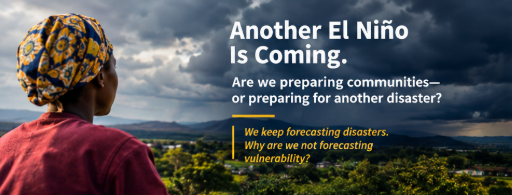
Another El Niño Is Coming. Are We Preparing Communities—or Preparing for Another Disaster?
By Susan Nzomo
We keep forecasting disasters. Why are we not forecasting vulnerability?
The warning signs are already here.
The World Meteorological Organization says a strong El Niño is developing and is expected to strengthen through August–October 2026, bringing significant shifts in rainfall patterns across different parts of the world. The U.S. Climate Prediction Center has put the likelihood of a very strong El Niño during the 2026–27 season at more than 90 percent.
In Kenya, the concern is particularly immediate. The country is already preparing for the potential disruption that El Niño could bring to agriculture, water resources and infrastructure, with the government seeking emergency financing to strengthen its response.
But perhaps we are asking the wrong question.
We keep asking:
How much rain will fall?
How many millimeters?
Which counties will receive more rainfall?
When will the rains begin?
These questions matter.
But there is another question we should be asking:
Who is most vulnerable when that rain comes?
Because a climate event does not create vulnerability equally.
A flood does not mean the same thing to a family living in a well-drained urban neighborhood as it does to a family living beside a river.
A disrupted road does not mean the same thing to someone working from home as it does to a pastoralist trying to reach a market with livestock.
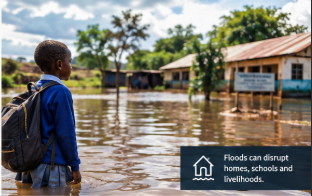
A flooded school is not simply damaged infrastructure. It can mean children missing classes, teachers unable to reach schools and families losing access to one of the few stable institutions in their community.
A failed harvest is not simply an agricultural statistic.
It can mean food prices rising.
Household income disappearing.
Children eating fewer meals.
Families selling productive assets.
Young people leaving home in search of work.
And communities becoming increasingly dependent on emergency assistance.
This is why El Niño is not simply a weather story. It is a justice story.
Food security begins long before the food crisis
When rainfall patterns change, farmers are among the first to feel the consequences.
Too much rain can destroy crops. Too little can reduce yields. Unpredictable rainfall makes it harder for farmers to decide when to plant, what to plant and how much to invest.
For pastoralist communities, the equation is equally serious.
Water availability, pasture, livestock health and access to markets are interconnected. When these systems are disrupted, livelihoods are disrupted.
And when livelihoods collapse, resilience becomes an increasingly expensive word.
We cannot keep telling communities to “be resilient” without asking whether we are investing in the systems that make resilience possible.
Resilience requires functioning water systems.
It requires climate information that reaches communities in a form they can use.
It requires roads that remain accessible.
It requires schools that can continue operating.
It requires functioning health services.
It requires social protection that can respond before families are pushed into crisis.
And it requires governments that do not wait until disaster has already happened to begin acting.
What happens to children when the rains come?
Climate discussions often focus on crops, roads and infrastructure.
But there is another piece of infrastructure we must protect:
the future of a child.
When floods disrupt schools, learning is interrupted.
When families lose income, education can become unaffordable.
When water sources are contaminated, children face increased health risks.
When families are displaced, children can lose not only their homes but also their routines, protection networks and sense of security.
This is why climate adaptation must include education and child protection.
A climate-resilient community should not simply have stronger drainage systems.
It should have schools capable of staying open, safe water systems, informed teachers, prepared local authorities and communities that know what to do before, during and after an emergency.
The question is not simply: Can the building withstand the rain?
The question is:
Can the community continue to live, learn, work and thrive when the rain comes?
And then there is displacement
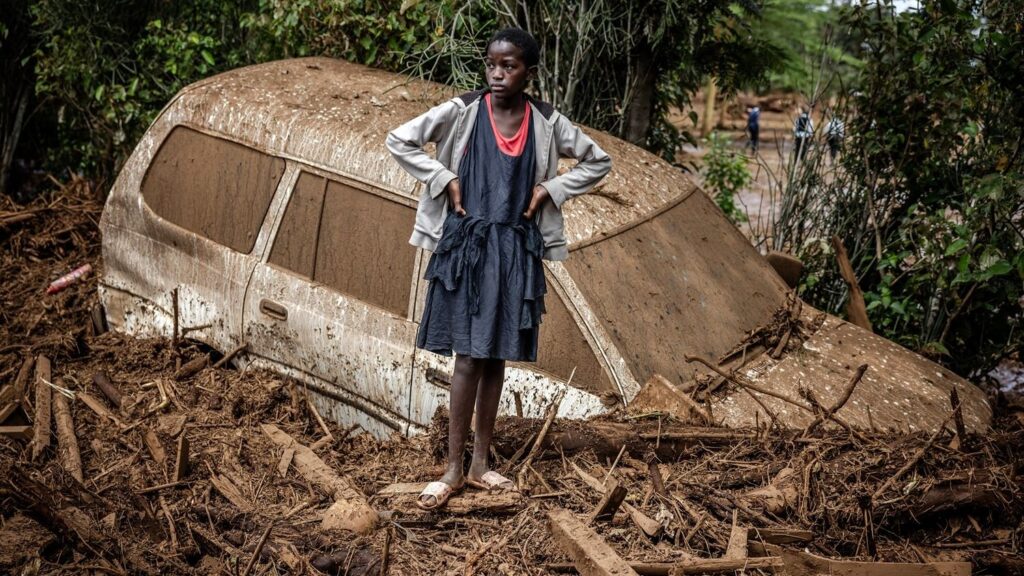
Disasters rarely remain disasters for one day. A flooded home can become temporary displacement. Temporary displacement can become loss of income. Loss of income can become debt. Debt can become migration. Migration can place additional pressure on already stretched communities and services. This is how a climate event can become a humanitarian, economic and social crisis. And this is why governments, development partners and humanitarian actors must stop treating climate preparedness as an emergency department issue.
Preparedness is development policy
It is education policy.
It is water policy.
It is agricultural policy.
It is infrastructure policy.
It is social protection policy.
It is governance.
So, are we actually preparing communities?
Kenya’s move to secure emergency financing in anticipation of multiple risks, including El Niño-related disruption, demonstrates that preparedness is already being taken seriously at national level.
But preparedness cannot only happen in Nairobi. It must reach the village, The school. The pastoralist settlement, The farmer, The market, The water point, The local government office, The community organization, And most importantly, the people who experience vulnerability first-hand. Communities should not only receive warnings. They should have a voice in deciding what preparedness looks like. They should know where resources are going. They should know who is responsible. They should have access to information before a crisis. They should participate in identifying the risks that threaten their livelihoods. And they should have mechanisms to hold institutions accountable when preparedness fails. This is where climate justice meets responsive governance.
Donors must also ask a different question
For development partners, the temptation during a crisis is understandable:
How quickly can we respond?
But perhaps another question deserves equal attention:
How much can we invest before the crisis?
There is enormous value in financing early action rather than repeatedly financing recovery.
A water system that prevents a community from becoming dependent on emergency water.
A school prepared for climate shocks.
A farmer equipped with climate information and resilient practices.
A pastoralist community with better water and livelihood systems.
A local government with functioning contingency plans.
A community that understands early warnings and has the power to act on them.
These may not produce dramatic photographs of emergency relief.
But they may prevent the emergency from becoming dramatic in the first place.
That is what meaningful climate investment should look like.
From forecasting disasters to forecasting vulnerability
The technology to forecast weather is improving.
The real challenge is whether we can translate forecasts into action.
When meteorologists tell us that an El Niño event is strengthening, the question for development actors should immediately become:
Where are the most vulnerable people?
Who will lose their crops?
Who will lose their livestock?
Which schools are at risk?
Which roads will become inaccessible?
Which communities will be displaced?
Where will water become unsafe?
Which families have no savings to fall back on?
Which local governments have the capacity to respond?
And who will be left out of the preparedness plans?
That is the difference between forecasting a disaster and forecasting vulnerability.
At Hakimani Eastern Africa, our work across Eastern Africa is grounded in a simple conviction: climate justice cannot be separated from human dignity, good governance and the ability of communities to shape decisions that affect their lives.
Because climate resilience is not just about surviving the next disaster.
It is about changing the conditions that make some communities repeatedly pay the highest price for a crisis they did the least to create.
So as another El Niño approaches, perhaps we should ask ourselves:
Are we preparing communities—or simply preparing to respond when they suffer?
Because the forecast has already given us a warning.
What we do with that warning is a question of justice.