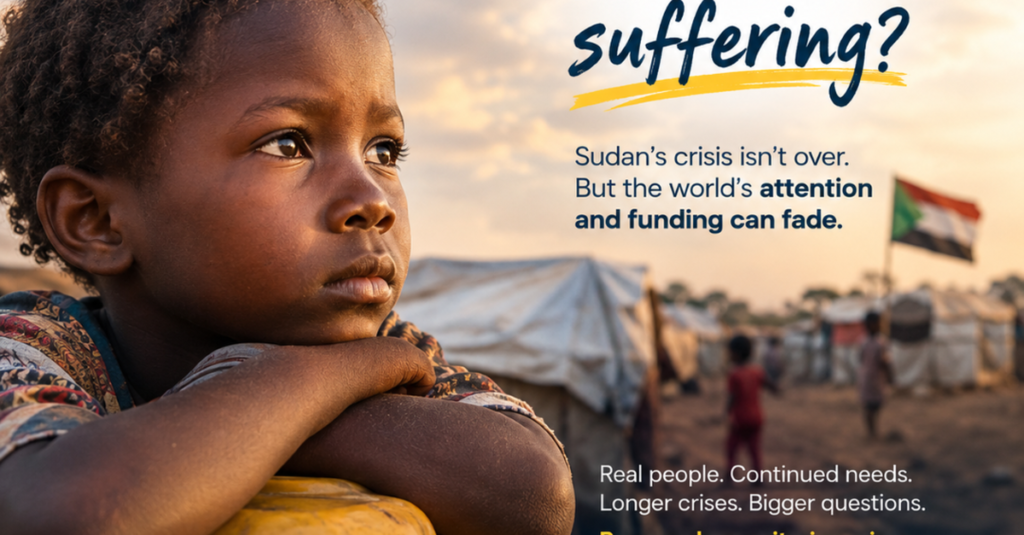
What happens when the world gets tired of your suffering?
By Ms. Susan Nzomo
Sudan’s war has entered its fourth year.
Yet an estimated 33.7 million people still require humanitarian assistance, including 17.3 million children. More than 9 million people remain internally displaced. And as of 31 July 2026, UNICEF had mobilised only 37% of the funding required for its Sudan humanitarian appeal, leaving a 63% funding gap.
These are not just numbers.
- Behind them are children who still need to learn.
- Families who still need food.
- Mothers who still need healthcare.
- Communities that are still hosting people forced from their homes.
- And people trying to rebuild lives in the middle of a crisis that has lasted far longer than most emergency funding cycles.
But there is something else happening.
The longer a crisis continues, the easier it becomes for the rest of the world to become accustomed to it.
The headlines move on, donor priorities shift, new emergencies demand attention, funding becomes harder to sustain, and eventually, a prolonged crisis risks becoming part of the background.
But hunger does not follow the news cycle.
Displacement does not have an expiry date; a child does not stop needing protection because the crisis has become less visible and a community does not stop needing support because the international community has moved on to its next emergency.
The consequences of funding shortfalls are already tangible.
In June 2026, the Sudan Health Cluster warned that the withdrawal of funding could affect or put at immediate risk 335 health facilities and services across 13 states, potentially affecting 3.35 million people. The reported disruptions included facilities being suspended or operating at reduced capacity.
Meanwhile, nearly 19.5 million people are facing crisis levels of acute hunger or worse, with areas at risk of famine. WFP says it urgently needs US$579 million to sustain operations through October 2026.
So we have to ask questions that are uncomfortable:
What happens when humanitarian funding ends before the crisis does?
- Who keeps the clinics open?
- Who protects children from hunger, disease and exploitation?
- Who supports communities hosting displaced families?
- Who keeps education alive when schools have been destroyed, damaged or repurposed?
- Who helps families rebuild livelihoods rather than remain trapped in cycles of emergency assistance?
And perhaps the most important question:
What happens to the people we stop reaching?
This is where the humanitarian conversation needs to become bigger than the next appeal.
Emergency assistance saves lives. It is indispensable.
But prolonged crises also require continuity, local leadership, resilience, livelihoods, social cohesion and systems that communities can rely on when international attention fluctuates.
For donors and development partners, the challenge is therefore not simply to give more. It is to ask whether the way we fund humanitarian action is keeping pace with the realities of prolonged crises.
Are we funding people to survive the emergency, or helping communities build the capacity to recover from it?
Flexible and sustained funding can help local organizations continue serving communities when international systems are stretched. Investment in health, education, water, livelihoods, protection and social cohesion can preserve dignity today while strengthening the foundations for tomorrow.
Because perhaps the real measure of solidarity is not how much we give when a crisis dominates our news feeds.
Perhaps it is whether we remain when the cameras leave.
At Hakimani Eastern Africa, we believe social transformation requires more than responding to immediate suffering. It requires walking with communities through crisis. It requires strengthening their agency. It requires supporting systems that make dignity, justice and peace possible not only for the duration of an emergency appeal, but for the long journey that follows.
Sudan must not become a forgotten crisis simply because it has become a prolonged one.
The world may move on from the headlines.
The people of Sudan cannot simply move on from the crisis.
So here is the question we want to put to this community:
When a humanitarian crisis becomes prolonged, what should responsible solidarity look like?
We would genuinely like to hear from humanitarian practitioners, donors, development partners, local organisations and policymakers:
How do we build a system that stays with people after the headlines disappear?
#Sudan #HumanitarianAction #HumanitarianCrisis #HumanDignity #SocialJustice #Peacebuilding #Localization #HumanitarianFunding #Development #HakimaniEasternAfrica